

We all have rights! Learn how to protect them and prepare for interactions with immigration enforcement.
Know Your Rights Cards
We all have protections under the U.S. Constitution. “Know Your Rights” Cards can help you to assert your rights and protect yourself.
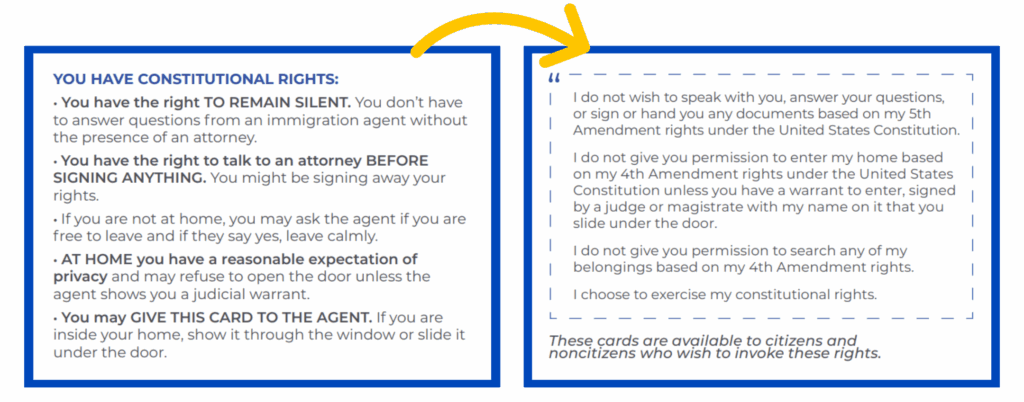
Download a copy to save to your phone or print.
Know Your Rights in Everyday Situations
All U.S. persons and immigrants have legal rights, regardless of their status. Learn how to protect your rights and prepare for contact with immigration.
You have the right to remain silent and may choose not to discuss your immigration or citizenship status with law enforcement. Anything you say can be used against you in court.
You have the right to talk to an attorney if you are ever stopped or questioned by law enforcement or immigration officers. However, keep in mind that when it comes to immigration issues, you do not have the right to a government-provided immigration attorney. If you need one, you’ll have to hire and pay for them yourself.
If you get arrested
Find out (or confirm) if they are charging you with a criminal offense or an immigration violation. You can:
- Ask an officer where you are detained, and/or ask a friend or relative to look for you in ICE’s Online Detainee Locator System (for immigration violations) and the Bureau of Prisons public locator system (for federal criminal charges).
- If you are charged with a criminal offense, you may use your right to remain silent and ask to talk to your federal defender.
- If you are afraid to go back to your country of origin, you may choose to tell your federal defender and the judge.
Documents to carry if…
What To Do If…
Documents you should keep with you if the police or immigration stops you
To protect your rights, know:
- what documents you should always have with you, and
- when to show them to immigration or police.
Follow these steps:
- Make copies of the documents listed below.
- Keep the originals in a safe place if they are not with you. Tell a relative or friend how to find them, if needed.
- You should not carry or show law enforcement anything that shows you were born outside the U.S., like a foreign passport. They can use that to try to deport you.
- Be ready. Find your situation below, practice, and be prepared.
If you have a valid immigration status
If you have valid immigration status, such as:
- a green card
- A REAL ID driver’s license
- asylum or refugee status
- A valid student or other visa
- unexpired TPS (Temporary Protected Status)
Carry: The law says you must carry with you your lawful permanent resident card or immigration papers that show your status.
Show: If law enforcement or an immigration officer asks to see your papers, show them your copy. If your documents show an expired date, be sure to carry a copy of any USCIS notice that explains the current status of your case.
If you are a naturalized U.S. citizen
If you are a naturalized U.S. citizen, carry proof of your citizenship, such as:
- a U.S. passport (current or expired)
- a U.S. passport card
- certificate of naturalization
- certificate of citizenship
- A REAL ID driver’s license although it is not proof of citizenship, it can be used as evidence of your lawful presence in the country.
- U.S. Citizen Identification Card (Form I-197 issued by the former INS). This card was issued to naturalized citizens who lived near the U.S. and is still valid proof.
Carry: While you are not legally required to carry proof of citizenship, you may choose to carry with you proof that shows you are a citizen.
Important reminders:
Naturalized citizens have equal rights: Naturalized citizens have the same rights as native-born citizens and their citizenship is secure if it was earned lawfully. Traveling domestically and returning from international travel as a U.S. citizen is safe and protected, provided you are not subject to denaturalization as outlined below. Note for Dual Citizens: always use your American passport when entering or leaving the United States to avoid complications.
Protection from denaturalization: While denaturalization does exist, it is extremely rare and only applies to cases of fraud or extraordinary national security threats. Usually, denaturalization occurs when the naturalized citizen was not actually eligible to naturalize at the time they were granted citizenship.
Denaturalization is not automatic: It requires a formal legal process, where the government must prove that you illegally acquired your citizenship in order to revoke it. It is a high burden of proof, and you have the right to defend yourself. Thus, naturalized citizens should rest assured: your citizenship is secure as long as it was earned lawfully.
If you do NOT have a valid immigration status
If you do NOT have valid immigration status, but you applied for status or have an open case, such as:
- A pending asylum application
- An open immigration court case
- An immigration appeal
Carry: Have a copy of your immigration papers that show you applied for status or are appealing an immigration decision.
Show: If you are arrested, provide your name and show your papers to the immigration agent. This will help your loved ones locate you more quickly.
If you are not arrested, remember you have the right to stay silent. You do not have to answer questions about your immigration status or provide documents unless required by law.
If you are undocumented or your immigration status is expired
If you are undocumented or your immigration status is expired:
Carry: If you do NOT have current immigration documents, but have been in the U.S. for at least 2 years, carry proof of your living here, such as:
- Your rental contract
- Church or school records with your address
- Mail that was sent to you at your home address, including the postmark that shows when it was mailed
- Other documents that show your name, a U.S. address, and date.
Show: Show proof of your living in the country for at least 2 years if you are arrested. This can protect you from quickly deporting you without seeing a judge. If you can’t prove you’ve lived in the U.S. for more than 2 years, they can deport you without giving you a chance to see a judge.
If you are not arrested, remember you have the right to stay silent. You do not have to answer questions about your immigration status or provide documents unless required by law.
Prepare for Different Scenarios
All persons in the United States have constitutional protections, including the right to remain silent when questioned or arrested by immigration officers. Being stopped by immigration officers or other law enforcement can be frightening, but it’s important to stay calm.
What To Do If…
You get stopped by immigration agents at work, on the street, or other public place
- STAY CALM. Do not run away or try to stop the agents.
- If you work in a place open to the public, like a restaurant, a car wash or a lobby, immigration agents MAY ENTER THE PUBLIC SPACE of your workplace as they please.
- If they ask you questions, you may say “I AM USING MY RIGHT TO REMAIN SILENT”. You are not required to answer questions from an immigration agent without the presence of an attorney such as where you were born, your immigration status, or your immigration history.
- You may give a KNOW YOUR RIGHTS CARD to the agent. You can print one here.
- You may ask the agent if you are FREE TO LEAVE and if they say yes, walk away calmly.
- You have the right to TALK TO AN ATTORNEY BEFORE SIGNING ANYTHING. You might be signing away important rights that protect you.
- If you are a U.S. citizen and feel safe to do so, RECORD THE ACTIVITY with your phone or write down any relevant information about what you witness—ALWAYS being careful to not interfere or otherwise obstruct the operation.
- ASK IF POSSIBLE what government agency they are from while recording.
Be Ready!
- Practice. Standing up for your rights is hard. Practice saying these phrases out loud. This will make it easier to say them if you get stopped.
- Memorize the phone numbers you might need to call in an emergency.
- Carry a Know Your Rights card in your wallet. You can print one here.
Immigration knocks on your door
- AT HOME YOU HAVE A REASONABLE EXPECTATION OF PRIVACY and may refuse to open the door unless the agent shows you a judicial warrant. You can talk to them from behind the door.
- ASK IF THEY ARE FROM IMMIGRATION and why they are there. Ask them to show you a badge or ID. They can hold it up to a peephole or a window. Many different law enforcement agencies (like police, and federal agents from the Drug Enforcement Administration (DEA)) are doing immigration enforcement now.
- Immigration agents can lie to you to get into your home. They may say they are investigating a crime or need to “talk or take a quick look around.” You may choose to say “YOU CANNOT COME INTO MY HOME WITHOUT A JUDICIAL WARRANT.”
- If they say they have a judicial warrant, you may ask them to slide it under the door or hold it up a window so you can read it. You may take a picture of the warrant.
- CHECK IF THE WARRANT IS VALID. Immigration agents may show you an “administrative warrant” that does NOT give them the right to enter your home. See Learn how to check if a warrant is valid below.
- IF THE WARRANT IS NOT VALID, you may say:
- “This is NOT a valid warrant. You do not have my permission to enter.”
- You may refuse to open the door and slide a Know Your Right Card under the door or show it through a window.
- If agents force their way in, DO NOT RESIST OR RUN AWAY. You can say, “I do not agree to you coming into or searching my home. I am using my right to remain silent. I want to speak with a lawyer right away.”
Be Ready!
Practice. Standing up for your rights is hard. Practice saying these phrases out loud. This will make it easier to say them if you get stopped. Learn how to check if a warrant is valid.
A valid judicial warrant will:
- Have the words “U.S. District Court” or the name of a state court on the top.
- List your name, the name of someone who lives in your home, or your home address.
- Be signed by a state, federal, or magistrate judge. Look for a signature. Also check if the signor’s title includes the word “Judge.” Only a judge — and NOT an “Immigration Judge” — can sign this type of warrant.
The warrant is NOT valid to enter your home if it:
- Says Department of Homeland Security (DHS) on top or has a seal or stamp that says “DHS.”
- Has the form number DHS Form I-200 or DHS Form I-205 on it.
- Is signed by an immigration agent, or an immigration judge.
You encounter an immigration officer while driving your car
- STOP YOUR VEHICLE AND TURN ON YOUR EMERGENCY LIGHTS. Slowly lower the window and place your hands in a visible location.
- You may choose to REMAIN SILENT. Show the police your drivers’ license. If asked, show your car registration and proof of insurance. But you still have the right to remain silent about everything else. Immigration can use anything you say against you. You have the right to refuse to give your consent for a search of yourself or your car.
- If you do not have a driver’s license, you should not show false documents.
- IF YOU ARE A PASSENGER, in most states you are not required to show a license or ID. Verify the Stop and ID laws applicable to your state. STAY CALM AND DO NOT RUN. Use your phone to take photos and notes about the stop, but stay calm and do not run.
- If they ask you questions, you may say “I AM USING MY RIGHT TOREMAIN SILENT”. You are not required to answer questions from an immigration agent without the presence of an attorney such as where you were born, your immigration status, or your immigration history.
You have the right to TALK TO AN ATTORNEY BEFORE SIGNING ANYTHING. You might be signing away important rights that protect you.
You encounter an immigration officer at the airport or border
- All workers and travelers have constitutional rights, such as the right to refuse unreasonable searches and seizures, the right to remain silent, and the right to expression. See more from the ACLU here. Should those rights be violated, it is critical to document the violations so that this information can be used in legal and organizing fightback efforts.
- It is also important to know that ICE has been arresting and detaining people at airports who have work authorization and who are lawfully present, such as those with DACA, asylum seekers, and green card applicants.
- Green card holders who have certain criminal convictions or have engaged in political activism that has placed them on the Administration’s radar may be at risk.
More info on risk of arrest by ICE at U.S. airports from the National Immigration Law Center is available here.
Disclaimer: This is not intended as legal advice. By sharing this information, UFCW aims to help members and their families access safe, reliable information, learn about their immigration options, and avoid scams. | For additional resources, please contact your Union Representative or visit www.ufcw.org/immihelp.”