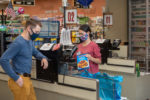

“States like New Jersey are already acting where the Commission is dropping the ball because they already know the threat that surveillance pricing and ESLs pose.”
WASHINGTON, D.C. – Today, the United Food and Commercial Workers International Union (UFCW), which represents 1.2 million essential workers across North America, released a statement in response to a new enforcement bulletin from the Federal Trade Commission (FTC) on the practice of personalized, or “surveillance,” pricing.
UFCW International Vice President Ademola Oyefeso said:
“Consumers need more than a disclosure to be protected from predatory pricing. Shoppers with limited choices cannot opt out of purchasing necessities that are priced using their personal data, and people with only one grocery store in town would simply be out of luck. We need a ban on surveillance pricing and the technologies that enable it, like electronic shelf labels.
“Additionally, the Federal Trade Commission’s admission that it does not already know the prevalence of surveillance pricing in our stores or online should ring alarm bells. Allowing these practices to advance without our knowledge will only make them harder to stop when regulators finally catch up. The Commission must restart its past inquiry into these practices immediately and tackle price gouging technologies like electronic shelf labels for the role they play.
“States like New Jersey are already acting where the Commission is dropping the ball because they already know the threat that surveillance pricing and electronic shelf labels pose. Lawmakers must leave no doubt for working families that the prices they see on the shelf at the grocery store are fair and that their data is not being weaponized against them.”
BACKGROUND
- The FTC notice states that it will require businesses to disclose when they use personalized pricing and may face lawsuits if they don’t. This comes after the FTC, under the Biden administration, initiated a study into the use of customer data to set individualized prices, which was abandoned shortly after President Trump took office.
- The UFCW has long advocated against surveillance pricing, most recently testifying at a Senate hearing on the cost of surveillance pricing to consumers and workers. With prices continuing to rise, affordability remains top of mind for UFCW members.
- Earlier this year, the UFCW launched the “Affordable Groceries and Good Jobs Campaign” to ban surveillance pricing and electronic shelf labels (ESLs) that enable the predatory practice in grocery stores. In the U.S. Senate, the Stop Price Gouging in Grocery Stores Act, led by Senator Ben Ray Luján (D-N.M.) and Senator Jeff Merkley (D-Ore.), was introduced in February, alongside a House companion bill, led by Representative Rashida Tlaib (D-Mich.-12) and Representative Val Hoyle (D-Ore.-4).
- States have also proposed their own legislation, with New Jersey leading the way by signing the Fair Price Protection Act into law last month. The bill bans surveillance pricing and institutes a moratorium on ESLs. Twelve other states have introduced the UFCW’s model legislation to target the encroachment of AI-driven technology in grocery stores and deliver fair prices for families while preserving good, union grocery jobs.
- Polling found that 65 percent of American voters think ESLs and 68 percent think surveillance pricing will cause grocery prices to increase. Sixty-seven percent of voters are in favor of banning this technology and practices in grocery stores, with support cutting across party lines. Seventy-two percent of respondents said they do not have faith in grocery stores to use this technology responsibly.
- ESLs enable retailers to change prices instantaneously, and corporations are racing to deploy them. Walmart, for example, plans to replace traditional paper price tags with digital ones across all of its stores by the end of 2026. The corporation also recently secured patents to use shoppers’ personal data to update prices at scale.
###
The UFCW International is the largest private sector union in the United States, representing 1.2 million workers and their families in grocery, meatpacking, food processing, healthcare, cannabis, retail, and other essential industries. UFCW members serve our communities in all 50 states, Canada, and Puerto Rico. Learn more about the UFCW at ufcw.org.